
You pass them every day: Shopping centers. Strip plazas. Neighborhood retail rows with a veterinarian on one end, a smoothie shop on the other, and a stream of cars sliding in and out of the parking lot from morning until night.
To most people, they are part of the scenery. They are where errands get run, where lunch gets picked up, where somebody grabs a coffee, drops off the dog, or swings in for one quick stop on the way home.
Yet if you train yourself to see what is really happening, you begin to understand that a shopping center is far more than a row of stores. It is a machine for producing income — and when you know how to buy it, lease it, improve it, and manage it, it can become a formidable wealth-building asset.
That is the first thing you must understand. You are buying much more than brick, stucco, roofing, and parking spaces. You are buying income. Better still, you are buying the chance to increase that income. That is where the real money is made. Shopping centres can generate income far beyond the rent collected from permanent tenants. Owners and investors can create ancillary revenue, improve the use of underperforming space and introduce services that increase the property’s total earning power.
The person who simply buys a fully rented center and sits back to collect checks may do well enough. The person who buys a center with a plan, improves it, fills space, strengthens the tenant mix, increases the net income, and then either refinances or sells has entered a very different class of opportunity.
In commercial real estate, the central figure is NOI — Net Operating Income. That is the income left after the property’s operating expenses are paid. Shopping centers are valued largely on that number. Once you grasp that fact, the whole business begins to make sense.
A property producing $500,000 a year in NOI at an 8% cap rate is worth $6,250,000.
Raise the NOI to $650,000, and at that same 8% cap rate the value becomes $8,125,000.
That is nearly $2 million in additional value created through action, judgment, and planning. Nothing mystical happened. You improved the income, and the market rewarded you for it.
Here’s how to get that done.
The Cap Rate Tells You Where the Money Is
One of the finest things about shopping-center investing is that the math is plain enough for any determined person to understand. The cap rate is simply the rate of return buyers use to value a property based on its NOI. The formula is straightforward:
Value = NOI ÷ Cap Rate
That means every decision you make should be tested against one question: will this increase the NOI? If it does, you are very likely creating value.
Consider a center producing $400,000 in NOI. At an 8% cap rate, it is worth $5,000,000. Now suppose you lease vacant space, clean up expenses, and improve the tenant mix until the NOI reaches $520,000. At the same cap rate, the value becomes $6,500,000. That additional $120,000 in annual income has created $1,500,000 in value.
That is why serious shopping-center money is made after the purchase. A good acquisition is more than a property with rent coming in. It is a property with room to improve the NOI.
Here are the principal ways you raise NOI in a shopping center:
- Fill vacant space
- Raise below-market rents
- Improve the tenant mix
- Reduce waste and unnecessary expense
- Add new income streams to the property
- Structure leases properly so costs are passed through
Each of these levers can produce surprising gains.
Why Vacant Space Can Be a Gift
Many buyers become uneasy when they see vacancy. They imagine trouble, delay, and uncertainty.
Yet in shopping centers, vacancy is often where the best opportunity lives. Empty space produces no income. Because it produces no income, it is not fully reflected in the cap-rate valuation of the property. In practical terms, that means you may be buying space that can later be turned into income and value.
Suppose a center has 10,000 square feet sitting empty. Market rent in that area is $24 per square foot. If you lease that space, you create $240,000 in annual rent. At an 8% cap rate, that added income translates into $3,000,000 in value.
That is why experienced retail buyers often prefer some vacancy to none at all. A perfectly stabilized center has its virtues, though much of the easy upside may already be gone. A center with manageable vacancy gives you room to create value.
This does not mean you buy blind. It means you buy with a plan. You want to know before you close what those units can rent for, what type of tenants belong there, what buildout may be required, and who in the market is likely to take the space.
A vacancy without a plan is dead space.
A vacancy with a plan is future wealth.
The IWS Neighborhood and Convenience Shopping Center Loan Package (M-1)
This illuminating report is an example of a general loan offer and description of shopping center loans available from a major commercial real estate lending group. This example is intended to be used for illustrative and information purposes only, and does not imply an endorsement of any kind. The publisher is not affiliated with the lender.
The Triple Net Lease Gives You Cleaner Income
One of the most important terms in shopping-center ownership is NNN — Triple Net. In a Triple Net lease, the tenant pays base rent plus a share of three principal expenses:
- Real estate taxes
- Property insurance
- CAM, or Common Area Maintenance
CAM covers the costs of keeping the shared parts of the property in shape — parking lot upkeep, lighting, landscaping, common-area utilities, and similar items. When your leases are truly NNN, you are pushing much of the operating burden back onto the tenants, where it belongs. That makes your base rent cleaner and your NOI stronger.
This is a major reason why shopping centers can become such effective income assets. In a poorly structured property, rising taxes, insurance premiums, and maintenance costs eat into the owner’s returns. In a well-structured retail center, those costs are largely recovered.
Imagine two identical centers, each collecting $600,000 in base rent. In one, the landlord absorbs a large portion of taxes, insurance, and maintenance. In the other, the tenants reimburse those costs under NNN leases. Which center would you rather own? The second, of course, because the income is more stable, more predictable, and more attractive to future buyers.
This is why you should care about lease structure. It is not technical fluff. In fact, it is the very architecture of profit.
A Real Example of Value Creation Through Space Reconfiguration
One of the smartest moves in retail is to look at a vacant box and ask whether it is the right size for today’s tenants. Many older centers contain spaces that are too large for the kind of local or regional tenants most likely to lease them quickly. A 2,800-square-foot or 3,000-square-foot unit may sit while smaller users search for 1,200 to 1,500 square feet.
Now let’s make this practical.
Suppose you have a 2,800-square-foot vacant space. As one large unit, it may attract little interest. What do you do? You decide to split it down the middle into two 1,400-square-foot spaces. To do that, you add another restroom, extend plumbing, create a second rear door, and arrange separate utility metering so each tenant pays for his own electric and water. You spend real money to do it, though you make the space far more useful.
Now instead of hunting for one tenant, you can pursue two.
Better still, smaller spaces often command higher rent per square foot.
Here is how the numbers can look:
- One 2,800-square-foot unit at $20 per square foot = $56,000 annual rent
- Two 1,400-square-foot units at $28 per square foot = $78,400 annual rent
That is an increase of $22,400 in annual rent. At an 8% cap rate, that creates $280,000 in additional value.
And that is before you consider the benefit of having two tenants instead of one, which spreads risk and often improves the center’s activity.
This kind of move is not glamorous. It is practical. It is exactly the kind of practical action that turns a sleepy center into a stronger one.

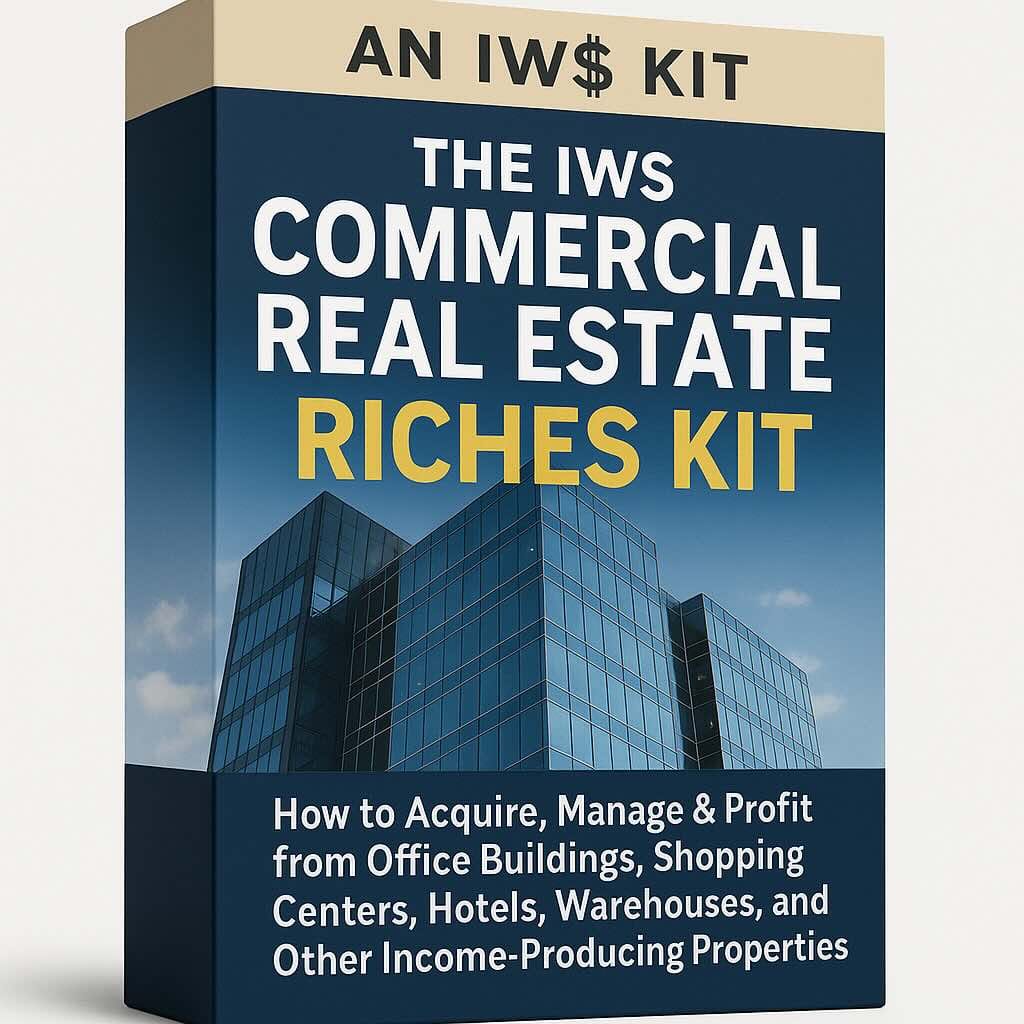

The IWS Commercial Real Estate Riches Kit (K-34)
Step into the big leagues of real estate investing with The IWS Commercial Real Estate Riches Kit by Tyler G. Hicks.
This powerhouse system gives you proven methods to find high-profit commercial properties, secure 100% financing, and negotiate million-dollar deals with confidence. Inside, you’ll access over 500 lenders—including private and specialty sources—and master the formulas and strategies the pros use to build unstoppable cash flow. Learn how to identify winning properties, calculate net positive returns, and structure deals that banks can’t refuse. With this kit, you gain the tools, insider knowledge, and connections to create real wealth in commercial real estate—fast, big, and for life.
The Best Tenants Are the Ones People Need
A shopping center becomes stronger when its tenants serve real, recurring, everyday demand. You want businesses that people return to again and again. This is sometimes called necessity retail, and it is one of the strongest concepts in the business.
Think about what that means in the real world. People will delay buying many things. They are much less likely to delay taking a sick dog to the veterinarian, picking up a meal, seeing a doctor, getting a prescription, or visiting a service business woven into everyday life. Those are the kinds of tenants that create repeat traffic and stronger staying power.
A veterinarian is an excellent example. A veterinary clinic often requires extensive buildout — special plumbing, treatment areas, exam rooms, and interior improvements tailored to the business. Once that money is spent, the tenant has every reason to stay put. That is a very different kind of tenant from someone who can pack up some shelves and leave at the end of a term.
Here are the kinds of tenants that often strengthen a neighborhood center:
- Veterinary clinics
- Medical or dental users
- Quick-service food concepts
- Smoothie or coffee shops
- Fitness users
- Personal-service businesses
- Discount or convenience retailers
- Tenants with a drive-thru, where permitted
The strongest tenant mix creates a destination. One customer comes for one service and notices another. Foot traffic rises. The property becomes more useful to the surrounding community, and that usefulness turns into income.
You Make More Money When You Think Beyond the Storefronts
One of the best lessons in shopping-center ownership is that the revenue potential of the property may not stop at the front doors of the tenants. You must learn to look at the entire site and ask what else can be monetized.
The parking lot is a perfect example. Most people see it as a necessary part of the property. A sharper eye sees additional value. Electric-vehicle charging stations, for example, can create a new stream of income or a revenue-sharing arrangement, while also bringing more people onto the property. Those people stay for a period of time while charging, and during that time they may shop, eat, or spend money with your tenants.
Even if a first arrangement is light on immediate rent, the traffic alone can improve the center’s performance. A later agreement, negotiated from a better position, may produce direct income as well. This is value-add thinking at work. You are squeezing more revenue out of ground you already own.
The same principle applies to pads, kiosks, signage, and outdoor-use areas. The question is always the same: what on this property can produce more income than it does now?
Professional Leasing Is Worth the Commission
A common mistake among smaller owners is to treat retail leasing as something anyone can do with a sign in the window and a little patience. That can be an expensive habit.
Every month a 2,000-square-foot space sits empty at $25 per square foot, you are losing more than $4,000 in monthly rent. Let that drag on for six months, and you have left $25,000 on the table, to say nothing of the value that income would support.
A strong retail leasing broker earns his fee.
- He knows the local market.
- He knows what rents are realistic.
- He knows which tenants are expanding.
- He knows how to market the space properly.
- He knows how to negotiate.
Typical leasing commissions may run in the range of 6% to 8%, sometimes split between the listing side and the tenant’s representative. That may sound like money out the door. In reality, the right lease signed sooner rather than later can be worth a great deal more than the commission.
Here again, you are not trying to save pennies. You are trying to increase NOI.
Capex Will Make You or Break You
This is where enthusiasm must be married to discipline. Shopping centers can produce handsome returns, though they also require real-world stewardship. The phrase you need to know here is capex, short for capital expenditures. These are the bigger-ticket costs that come with ownership —
- roofs
- major paving
- structural repairs
- storm damage
- major site work
- significant exterior improvements
- large mechanical replacements
Some newer buyers focus so heavily on rent that they forget the physical plant itself. That is a mistake. The center has to be maintained. Tenants want a landlord who keeps the property in shape. Prospective buyers want to see a site that has been cared for.
At the same time, you must avoid foolish overbuilding. There is a great difference between useful improvement and expensive vanity. A handsome improvement that supports higher rents can be a fine move. A flourish that costs a fortune and adds little to rent or value is something else entirely.
Suppose you carve out a parcel or add a freestanding building on land you already own. You spend $2,000,000 to construct it. You line up quality tenants before or during the build. When complete, the income from that new leased building causes the market to value it at $5,000,000 or even $6,000,000. That is excellent value creation.
On the other hand, if you overengineer that same building with decorative features, expensive systems, or unnecessary complexity that add little to rents, you have reduced your own gain. The lesson is plain: build to the market, not to your ego.
A Short Case Study in Shopping-Center Wealth
Let’s pull several of these ideas together in one simple example.
You acquire a neighborhood center for $5,500,000.
At purchase, it produces $440,000 in NOI, which works out to an 8% cap.
The property has 8,000 square feet of vacancy, a tired façade, and one oversized unit that has been hard to lease.
Ancillary Income Ideas for Shopping Centers
Before you close, you study the area. You learn that small service spaces are in demand. You identify likely tenants — a veterinarian, a smoothie concept, and another daily-needs user. You budget for modest renovations, separate utility metering, and a split of the oversized unit.
Over the next year, you do the following:
- Split one oversized vacancy into two smaller spaces
- Lease 8,000 square feet at an average of $26 per square foot
- Tighten CAM recovery
- Replace one weak tenant with a stronger necessity user
- Add a parking-lot use that produces ancillary income
- Improve the appearance of the center enough to support better leasing
Now let’s say the numbers look like this:
- New rent from formerly vacant space: $208,000
- Better recovery and cleaner lease structure: $22,000
- Additional ancillary income: $20,000
- Net gain after added expenses and realistic adjustments: $190,000
That takes NOI from $440,000 to $630,000.
At an 8% cap rate, the value becomes $7,875,000.
You have created $2,375,000 in value.
That is how shopping-center wealth is built — by improving it.
What You Should Examine Before You Buy
When you look at a shopping center, you want more than a rent roll and a pretty brochure. You want to know where the hidden value is and what it will take to bring it to life.
Here are some of the questions you should ask:
- How much of the center is vacant?
- What is the current NOI?
- What cap rate am I buying at?
- Are the leases truly NNN?
- How are CAM charges being handled and reconciled?
- Are rents below market?
- Which tenants are strong, and which are weak?
- Can oversized spaces be divided?
- Are utilities separately metered?
- What capex is likely in the next three to five years?
- Is there excess land, parking-lot opportunity, or other ancillary income potential?
- What kind of tenants best fit this location?
When you begin asking those questions, you stop thinking like a casual buyer and start thinking like someone building wealth on purpose.
The Real Attraction of Shopping Centers
What makes shopping centers so compelling is that the levers are visible.
- You can see the vacancy.
- You can read the leases.
- You can inspect the property.
- You can study the traffic patterns.
- You can calculate the value created by more rent, cleaner reimbursements, better tenants, stronger management, and additional uses of the site.
This is not a mysterious business. It is a business of judgment, planning, and execution.
You do your homework. You decide what the property can become. You buy with a plan. You improve the income. You increase the NOI. The cap rate then translates those improvements into value.
That is the cycle.
And when you do it once, you can do it again.
A shopping center may look ordinary when you pass it on the road. To you, it should begin to look very different. It should look like square footage, leases, CAM recovery, NNN structure, tenant mix, capex, and NOI. It should look like potential waiting for someone with the vision to see it and the discipline to act on it.
That is where the money is.
Explore the IW$ real estate library for additional methods of acquiring, financing and profiting from income-producing property.
























ATTAIN : The Magazine for Wealth-Builders Worldwide Since 1966
ATTAIN : Access for Wealth-Builders Worldwide Since 1966, formerly simply called the IW$ Newsletter, has been published monthly since 1966, is your trusted guide to building wealth and achieving financial freedom. Each issue delivers 16+ pages of actionable insights, including:
- Money-making ideas for part-time ventures, real businesses, and franchises.
- Funding sources like lenders, government grants, and real estate financing tips.
- Export-import trade leads, mail-order opportunities, and cosigner listings.
Subscribers also receive a FREE classified ad in every issue, reaching an international audience of entrepreneurs and investors—perfect for finding partners, funding, or selling products.
ATTAIN will inspire and empower you every month.
If you can dream it, IWS will show you how!