
Contractor estimate follow up could be the beginning of an unusually practical little business for you. Consider a roofer who visits ten homes, measures each roof, prepares ten written quotations, and then spends the next three weeks climbing ladders. He sends the estimates, but several homeowners never tell him whether they want the work. The quotations sit in his computer while he works on the next job.
Now here’s the question I want you to ask: What if you offered to follow up on those unfinished estimates for him, arrange appointments with interested customers, and give him a report showing exactly what happened?
You wouldn’t have to climb onto a roof. You wouldn’t have to calculate a roofing estimate. And you wouldn’t need to pretend that artificial intelligence can make an uncertain homeowner buy a $10,000 roof. You would be providing a service that plenty of busy business owners understand immediately: making sure a prospective customer receives a courteous, useful follow-up rather than being forgotten.
You can begin with one contractor, a spreadsheet, the contractor’s approved messages, and a modest fixed fee. Later, you can help several contractors on a regular schedule. So let’s see how to get the first one!
The $120,000 File of Unaccepted Estimates
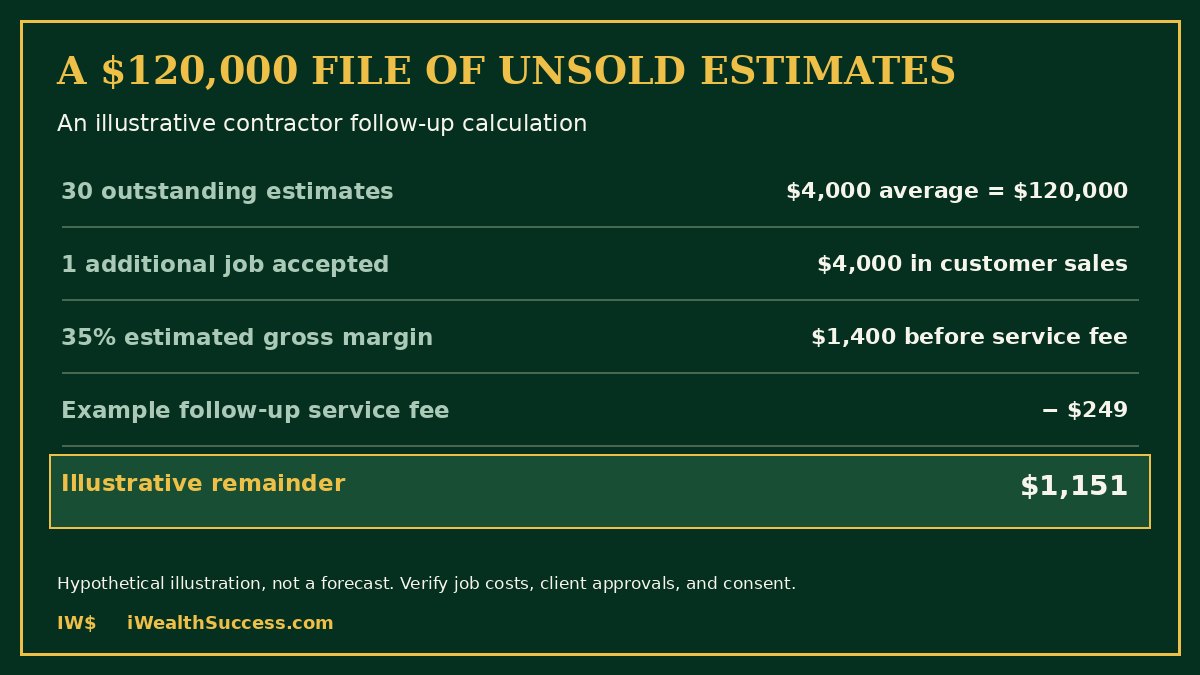
Suppose a small home-improvement firm has 30 open estimates averaging $4,000 each. That’s $120,000 in proposed work. Some customers have chosen another contractor; some are still deciding; others have postponed the job. The $120,000 figure represents potential sales, not cash in the bank and certainly not a promise that the customers will buy.
Now suppose your careful follow-up helps one of those customers decide to accept a $4,000 job. If that particular job carries an illustrative 35% gross margin, it contributes $1,400 after its direct job costs. If the contractor pays your agreed $249 trial fee, the hypothetical amount remaining is $1,151 before general overhead, taxes, and any other costs. The arithmetic is simple. The difficulty is finding the real client, doing the work well, and measuring what actually changes.
What about you? Imagine selling a $249 trial to four contractors. Four completed trials would bring in $996 in gross service revenue, before your own costs and taxes. Ten $249 trials would be $2,490. These are calculations, not forecasts. Your job is to discover whether owners value the service enough to buy it again.
A study is useful only when it changes your behavior. The lesson here is to look for business already quoted but not yet decided. The owner has performed the expensive first step of visiting the customer and producing the estimate. You help him finish the conversation.
Step 1. Choose a Trade for Your Contractor Estimate Follow Up Business
If you’re beginning with little experience, start with roofers, painters, window installers, landscaping companies, HVAC contractors, or flooring companies. Choose one group. Learn the language its customers use, the usual questions after a quotation, and the people who approve appointments. A contractor who has just paid an estimator to measure forty windows knows what an unanswered quotation costs in time.
Your first advertisement should say exactly what you will do. I would test this:
THE UNFINISHED ESTIMATE CHECKUP
Have 20 to 50 estimates waiting for an answer? I’ll organize the open quotations, prepare a courteous follow-up plan, help send owner-approved messages, and give you a report of interested customers and appointments. Fixed-price pilot: $249.
Notice what the offer promises: a defined job, a report, and a price. It makes no claims about a particular number of sales. That’s important because you control the follow-up work, while the owner controls pricing, capacity, and the decision to accept a job.
Step 2. Find Ten Contractors Who Already Write Estimates
You don’t need an elaborate website to begin. Open a public business directory and choose ten local companies in the same trade. Look for established businesses that advertise free estimates, in-home consultations, or quotations. Prepare a simple list containing the company, contact person, telephone number, and date of your approach.
Call during a reasonable business hour. Speak to the owner or office manager. I would say:
Hello! I help [roofing / painting / window] contractors follow up on written estimates that haven’t received a final answer. I offer a fixed-price checkup of up to thirty eligible quotations, with message drafts for your approval and a simple report showing who wants to talk. Do you have any estimates from the last month or two that are still waiting for a decision?
But, you ask, what if the person says, ‘We already follow up’? Wonderful. Ask what system they use, how often they check it, and whether anyone wants extra help when work gets busy. You may discover a company that is already organized. Move on courteously. Another company will tell you its owner has been meaning to do this for weeks.
Your immediate assignment is five calls, not five hours researching software. A service becomes a business when somebody agrees to buy it.
Step 3. Offer a $249 Thirty-Estimate Pilot
I would begin with a trial lasting seven to ten business days. For $249, offer to organize up to thirty eligible quotations, prepare approved follow-up drafts, help the owner deliver them through an appropriate authorized channel, log responses, and produce a final summary. Agree in writing on exactly what is included and how much additional work costs. These prices are suggested experiments; you’ll need to test what your market accepts.
Charge before substantial work begins, or arrange a clear deposit. Let the owner retain control of all customer relationships, pricing, and purchasing decisions. You’re providing research, organization, and follow-up administration, not legal advice, construction advice, financing, or a guarantee that work will be sold.
In the agreement, specify the number and age of estimates, which communication channels are approved, who sends the messages, the number of contacts permitted, how you handle replies and opt-outs, whether you’ll have access to customer information, when you deliver the report, and when your work ends. If the owner wants you to send messages or access records, establish the appropriate permissions and security arrangements first.
Step 4. Build the Unaccepted Estimate Ledger
The entire operation begins with a spreadsheet. Ask the contractor to identify eligible quotations and enter the minimum information needed for each one. Your working ledger should contain these columns:
- Estimate reference number and date, with customer details kept inside the contractor’s approved system.
- Type of work, estimated price, and whether the quotation is still valid.
- Current status: awaiting response, needs a question answered, appointment requested, declined, or completed.
- Owner-approved channel for contact and the relevant consent or opt-out record.
- Date of last contact, next appropriate action, person responsible, and eventual result.
Now I want you to be careful about something. An old quotation does not automatically give permission to send promotional texts or automated calls. The contractor must check applicable consent requirements and local law before any such outreach. For your first project, it’s perfectly reasonable to draft messages and have the contractor send them through its existing, compliant system. That lets you perform the useful work without acquiring customer passwords or operating a mass-texting platform.
And don’t put the full customer file into an AI chatbot. Start with redacted records, using reference numbers and generalized job types. You can produce excellent drafts without exposing someone’s home address, telephone number, or private project details.
Step 5. Sort the Estimates Before Writing a Single Message
Twenty-five eligible quotations might produce five different situations. A homeowner who requested a bid yesterday should receive a different note from one who postponed a renovation in April. Separate the list into these groups:
- Recently quoted: the buyer has the estimate, and a reasonable opportunity for questions remains.
- Interested, needs information: the buyer asked about timing, materials, warranty, or a work detail.
- Postponed: the buyer previously asked the contractor to check back later.
- Older, unresolved: the contractor must first verify whether further contact would be appropriate and welcomed.
- Closed or opted out: do not send another marketing follow-up.
The point of this sorting is to give the owner a useful decision, not merely generate a dozen messages. If five customers explicitly declined, mark them closed. If three asked for a new installation date, have the owner supply real availability. If two asked about financing, refer those questions back to the contractor and qualified providers rather than invent financing terms.
Step 6. Use AI to Draft Better Follow-Ups in Minutes
Here AI can genuinely help you. Give it the permitted, redacted facts and ask for short, human messages. You must check every sentence before the owner approves it. AI should never invent a discount, a deadline, a warranty, an appointment, or a statement about what the homeowner said.
AI Prompt 1: Sort the Work
You are helping me organize a contractor’s unaccepted written estimates. Here are redacted entries showing reference number, date, type of work, status, and the customer’s last stated preference. Group them as recent, needs information, postponed, old/unresolved, or closed. Suggest a careful next action for each group. Flag missing consent, expired estimates, and unknown facts. Do not invent customer details or approve outreach: [paste redacted entries].
AI Prompt 2: Write Three Useful Messages
Write three short, friendly follow-up email drafts for a [trade] company. The customer previously requested a written estimate for [verified work]. Use only these approved facts: [facts]. Draft one simple check-in, one helpful question about the estimate, and one final courteous note. Do not claim a discount, a deadline, limited availability, or customer consent unless provided. Do not use pressure tactics. Include a clear way to decline further marketing contact.
AI Prompt 3: Help the Owner Answer Questions
Prepare a list of common questions a homeowner might ask after receiving a [trade] estimate. Separate questions the office can answer from those requiring the contractor’s professional judgment. Do not invent product specifications, project prices, availability, guarantees, financing, or building-code requirements. Create a handoff checklist for the owner.
You will quickly notice something interesting: your greatest value is not the words AI puts on the screen. It is your ability to give the contractor a clean list of the questions and opportunities that deserve attention.
Step 7. Send Only Approved Messages Through Approved Channels
Show every draft to the contractor. The owner approves the customer group, the content, and the timing. Where marketing email is involved, follow the Federal Trade Commission’s CAN-SPAM compliance guidance, including accurate sender information, a valid mailing address, and an effective opt-out procedure. The FTC also explains that hiring another company to handle marketing does not eliminate the seller’s compliance responsibilities.
For promotional text messages, prerecorded calls, or automated dialing, the FCC’s telephone-marketing rules and applicable state laws may require additional consent and controls. A record that someone once requested a price is not enough by itself to assume permission for every sort of message. Verify the permitted channel and any revocation of consent before contacting anyone.
My starting recommendation is simple: let the client send approved individual email follow-ups through its established account or system. If a customer replies, the office or authorized staff member handles the response. No secret mass mailing, no scraped homeowner lists, and no messages from a stranger pretending to be the contractor.
One Follow-Up Message You Can Show a Contractor
Subject: A quick question about your [type of work] estimate
Hello [First Name],
Thank you for asking [Business] to prepare an estimate for your [project]. I wanted to check whether you’ve had a chance to review it and whether there’s anything we can explain before you make a decision.
If you’d like to speak with [Owner/Estimator], just reply and we’ll arrange a suitable time.
[Approved signature and contact information]
What does this message do? It opens a conversation. The homeowner can ask a question, arrange a call, decline, or do nothing. Good business does not require pestering people. It requires being helpful and following through when invited.
Step 8. Hand the Responses Back and Measure the Real Result
When somebody asks a question, wants a revised estimate, or requests an appointment, record it accurately and tell the owner. Never negotiate a contractor’s price without explicit authority. Do not mark a job ‘sold’ because a homeowner says, ‘I’m thinking about it.’
Your report should give the contractor the following: estimates reviewed, eligible contacts, approved follow-ups actually sent, replies received, appointments requested, jobs confirmed by the owner, and contacts closed or opted out. Include a brief section of recurring customer questions. This report is what your customer is paying for.
Let’s look at the money again. Suppose your client had thirty $4,000 estimates, so $120,000 of potential quoted work. After your pilot, one customer accepts a $4,000 job. At an illustrative 35% gross margin, that job contributes $1,400 before overhead. Less your $249 pilot fee, that leaves $1,151 before the owner’s additional expenses and taxes. But suppose nobody buys. Then your report should say so, explain what actually happened, and suggest whether a different customer group or timing might work better.
Do you see the lesson? You are building a reliable service, and the owner is buying organized follow-through. If the information shows the wrong time of year, the wrong price, or weak customer interest, that is useful too.
Step 9. Turn the Trial Into a Monthly Business
After the trial, ask the owner whether he wants a regular weekly check on eligible new quotations. A continuing offer might be $199 per month for a small, clearly limited review and reporting package, with additional work priced separately. That’s another test price, not a universal market rate. Four such clients would represent $796 in monthly gross service revenue. Ten would represent $1,990, before your expenses and taxes.
Now here’s where the business can become larger than one person’s spare time. Write down your steps: receive approved estimates, identify valid statuses, prepare drafts, obtain approval, log contacts, report replies, and invoice. Once that routine works, another careful assistant may be able to perform much of the clerical work while you find and manage customers.
Later you can offer related services such as maintaining an estimate-status ledger, preparing rebooking reminders, answering customer questions from approved materials, or reviewing a contractor’s customer-communication process. Stay within what the owner authorizes and what you can do competently. Each new service should solve one measurable problem.
Your Seven-Day Assignment: Get Your First Contractor Estimate Follow Up Client
- Day 1: Choose one trade and write the $249 thirty-estimate offer on one page. Include deliverables, deadline, and exclusions.
- Day 2: List twenty local contractors and their public contact information. Ask two owners how they currently check on unfinished estimates.
- Day 3: Make ten targeted calls. Speak to the owner or office manager and ask whether a limited pilot would help.
- Day 4: Finish the next ten approaches, demonstrate the blank tracking sheet, and show a sample follow-up draft.
- Day 5: Agree on a written pilot with one willing contractor, obtain authorization and approved records, and check the lawful contact methods.
- Day 6: Organize eligible estimates, prepare the approved drafts, and help the owner carry out the permitted follow-ups.
- Day 7: Deliver a progress report, record your customer’s reaction, and ask what would make the service worth buying every month.
There is no magic in owning a spreadsheet. There is plenty of opportunity in finding a businessman who is too busy to follow up on every estimate and helping him do it properly. You will learn more from twenty conversations with actual contractors than from six weeks of daydreaming about being your own boss.
How to Find More Customers and Build Your Direct-Marketing Skills
The next step is to learn how to make offers that people understand quickly, test whether those offers produce replies, and continue finding customers. That’s the business of direct marketing. If you want a deeper study of customer lists, offers, response advertising, and practical selling methods, take a look at The IW$ Mail Order and Direct Marketing Wealth Builder Kit (K-4). You can apply its direct-response principles to your own search for contractor clients, and to other businesses you may start in the future.

Start Your Contractor Estimate Follow Up Business Today
Before this day is over, pick one trade, write down five local companies, and ask each one: ‘How many written estimates are you still waiting to hear back about?’ Listen carefully. If an owner tells you that his office has a backlog and no one is handling it, you’ve found a real problem worth discussing.
Give the owner a simple proposal. Do the work. Report what happened. Ask for the next assignment. And remember that you can build a remarkably useful business out of a job other people keep putting off, provided you work carefully, treat customers properly, and keep trying!