

Suppose a customer hands you a purchase order for $100,000. You can supply exactly what the customer wants. Your supplier can deliver the goods. There is only one problem: the supplier wants $68,000 before shipping, and your customer will pay after delivery. You do not have $68,000 sitting in the bank.
What would you do? Turn down the order? Ask the customer to wait? Borrow against your house? Before you make any of those decisions, I want you to investigate an idea that has helped merchants and distributors grow for many years: purchase order financing.
Purchase order financing may allow a specialized finance company to pay your supplier for goods covered by a confirmed customer order. The goods are delivered, the customer pays according to the agreed terms, and the finance company receives what it is owed. You receive the balance after the transaction’s financing and other costs. The customer order helps make the financing possible.
Can every beginning businessman get such financing? No. A lender must like the buyer, the supplier, the merchandise, the contract, and the likely repayment. But that is exactly why I want you to learn the method now. A good order may be a financing asset rather than a problem you cannot afford to fulfill.
The Big Idea: Finance the Order, Not Just the Business
Many new businessmen ask a bank to lend money to their company. A lender may look at their limited trading history and say no. Purchase order financing asks a more specific question: Is there a genuine buyer, a credible supplier, a profitable transaction, and an acceptable way for the financing company to be repaid?
The U.S. Office of the Comptroller of the Currency explains that trade financiers can help sellers bridge the period between production and receiving payment from buyers. The OCC’s Trade Finance and Services handbook describes purchase-order and accounts-receivable finance as established forms of commercial funding. The British Business Bank’s practical guide also explains how suppliers and customers are assessed.
The idea has deep roots in Tyler G. Hicks’ own teachings. In the Generational Wealth collection, he described Ben, an entrepreneur who located overseas buyers, obtained product orders, used those orders to arrange financing, bought and shipped the goods, repaid the money, and kept the remaining profit. That is a historical Hicks example, not a promise that a modern lender will accept every order. The lesson, however, is powerful: learn to assemble a transaction before assuming that you must personally supply all its cash.
What a $100,000 Order Might Leave You
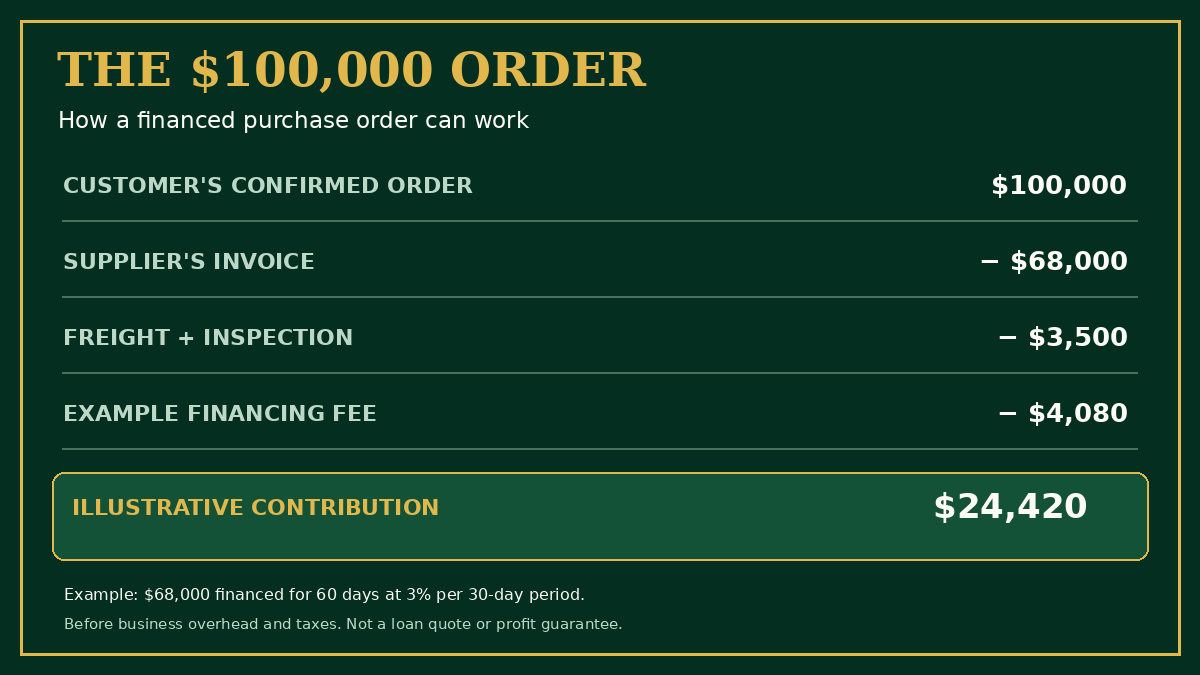
Let’s work through a hypothetical transaction. You have a confirmed $100,000 order from a business buyer. Your supplier’s price is $68,000. Your separate estimated freight and inspection costs total $3,500. Suppose a specialty lender agrees to finance the full $68,000 supplier bill and charges an illustrative 3% of the financed amount per 30-day period. The goods take thirty days to prepare and deliver, and your customer pays thirty days later. The money is outstanding for sixty days.
- Customer’s purchase order: $100,000.
- Supplier cost funded by the lender: $68,000.
- Freight and inspection paid from another source: $3,500.
- Illustrative finance fee: $68,000 × 3% × 2 periods = $4,080.
- Illustrative contribution remaining: $100,000 − $68,000 − $3,500 − $4,080 = $24,420 before overhead, taxes, returns, warranty costs, and other expenses.
Is that $24,420 free money? Certainly not! You still had to win the buyer’s business, locate a trustworthy supplier, obtain financing, supervise delivery, and accept the commercial risks of the transaction. You also needed a way to pay the $3,500 that the example lender did not cover. A real financing quotation can include minimum fees, origination charges, reserves, legal costs, guarantees, or other provisions. We are illustrating the cash flow, not quoting a lender.
And notice what happens if your customer pays thirty days late. At the assumed 3% per 30 days, an extra month could add $2,040 in financing costs, reducing the illustrative contribution to $22,380. This is why you must consider time as carefully as the selling price.
Step 1. Get a Real Purchase Order from a Real Buyer
Your first job is not to hunt for a lender. It is to establish that a buyer actually wants the merchandise, in a specified quantity, at an agreed price, by an agreed date. A telephone inquiry about a possible purchase is not enough.
Ask for a properly authorized purchase order or binding contract showing the buyer’s legal name, goods, quantities, specifications, price, delivery arrangements, acceptance requirements, payment terms, and cancellation provisions. Have someone knowledgeable review any unusual terms. A buyer’s purchase order may allow cancellation, deductions, or rejection, so don’t assume every printed order is guaranteed money.
Where could you find buyers? Local manufacturers, office-supply purchasers, specialty retailers, equipment dealers, wholesalers, government contractors, and import-export firms all buy products. Start in a field you can understand. You can also talk to suppliers and ask which kinds of customers commonly need the goods they distribute.
Here’s a useful opening question: ‘What products are you planning to buy in the next sixty days, and would you consider a qualified supplier who can give you a firm written quotation?’
But, you ask, ‘What if I have no trading history?’ Then concentrate first on introductions, samples, small transactions, supplier relationships, and orders that you can responsibly handle. A lender may require evidence that you can manage the transaction. Build that evidence one step at a time.
Step 2. Get Your Supplier’s Written Price and Delivery Promise
Now you know what the buyer wants. Find a supplier that can provide it, and obtain a written quote stating exactly what will be delivered, when it will be ready, and what the supplier requires before it releases the goods.
Your supplier information sheet should identify the supplier’s legal business, address, authorized representative, product specifications, units, manufacturing or sourcing schedule, inspection procedures, warranties, return conditions, and exact payment instructions. Ask whether the supplier has completed similar orders. Ask for references when appropriate.
Do not pay an unknown supplier simply because an invoice looks official. Verify the company through independent sources, obtain credible bank-payment instructions, and clarify who is responsible for damage, quality failures, and missed deadlines. Many purchase order financing arrangements pay the supplier directly. The lender will want to know where the money goes.
Here’s something else to try: ask the supplier whether it will extend some of the needed credit itself. Tyler repeatedly recommended seeking commercial credit from suppliers. He urged readers to list likely suppliers, inquire about available terms, compare the terms, and negotiate the period they need. Supplier credit may prove cheaper and simpler than outside finance, although a supplier is free to decline.
Step 3. Calculate Your Profit Before You Ask for Money
A big purchase order can make you feel rich before you have made a cent. Resist that temptation. The only worthwhile deal is one that still works after you calculate every expense.
Make a written estimate containing your sales price, supplier charge, import duties if applicable, freight, shipping insurance, quality inspection, storage, packaging, payment-processing costs, taxes, broker commissions, financing fees, expected delays, and a reasonable contingency. Separate money you need before delivery from money due later.
Then ask two questions: How much cash is missing before shipment? And how much is left if the order takes thirty days longer than planned?
I would use three cash-flow cases: an expected delivery and payment date, a thirty-day delay, and a serious problem requiring rework or a disputed invoice. If the third case could ruin you, change the contract or the transaction before moving ahead.
Step 4. Find Out Whether the Buyer Can and Will Pay
A purchase order is useful only if the customer can meet its obligations. A finance company may examine the buyer’s creditworthiness, payment history, business standing, purchase contract, and ability to accept delivery. This is not the same as saying the lender never considers your own financial situation. Many finance companies also review the merchant and supplier.
Ask the buyer who approves invoices, what constitutes acceptance, how disputes are handled, whether a supplier can contact the buyer to verify the order, and whether receivables may be assigned to a finance company. Do not conceal your intended financing structure. The buyer may have policies about assignment or direct payment.
If the buyer demands ninety-day terms and the goods take forty-five days to produce, remember that you could be financing the transaction for more than four months. Recalculate the costs and decide whether the margin still justifies the risk.
Step 5. Ask for Customer Deposits and Supplier Terms First
The least expensive source of working capital may be inside the transaction itself. Sometimes a business buyer will make a deposit for custom goods, or a supplier will accept a partial payment and the balance after delivery. Neither arrangement is automatic, but both are worth negotiating.
Suppose the buyer agrees to a legitimate 20% deposit on a $100,000 order. You now have $20,000 toward the transaction, subject to the written contract and any legal obligations to safeguard or refund deposits. If the supplier agrees to ship after receiving $30,000 and lets you pay the balance later, you may need far less outside funding.
Do not misuse deposits or make promises you cannot keep. Put the schedule, refund rules, inspection conditions, and consequences of cancellation in writing. Some orders require surety, special treatment of deposits, or other safeguards. A qualified adviser can help you structure these terms.
Supplier script: ‘I have a verified customer order for [goods], with delivery needed on [date]. If we provide the signed order and acceptable references, what terms could you offer: a partial deposit, net terms, or payment through an approved finance company?’
The point is to negotiate with everyone who benefits from the completed sale before assuming that a traditional loan is your only choice.
Step 6. Compare Purchase Order Financing with Other Working-Capital Methods
If a funding gap remains, contact specialized purchase order finance providers and commercial lenders. Ask whether they finance your type of merchandise, minimum transaction size, location, customer profile, and supplier arrangements. Many PO financers focus on tangible goods and qualified business-to-business orders rather than speculative sales or ordinary service contracts.
You should also know the alternatives. An accounts-receivable factor generally works with an invoice for goods or services already delivered, so it may not solve the problem of paying a supplier before shipment. A business line of credit may offer flexibility, but its approval often depends on business qualifications and collateral. Supplier credit and customer deposits are negotiated directly within the transaction.
The U.S. Small Business Administration also operates a 7(a) Working Capital Pilot program under which participating lenders can provide qualifying transaction-based or asset-based lines of credit. The SBA explains that the pilot is designed to support working capital, including the fulfillment of contracts and inventory needs. It is not a guarantee that your order will qualify, and it may have an entirely different underwriting process from a private PO finance company.
For each proposed facility, ask for the full written fee schedule and a sample settlement statement. How is the fee measured? When does it begin? Is it computed on funds advanced, the invoice amount, or another basis? What happens on a payment dispute, returned merchandise, or customer bankruptcy? Is there personal recourse? Who controls the receivable? Are there renewal fees, minimums, reserves, or legal costs?
One good deal deserves more than one quotation. Compare at least three viable financing approaches before signing.
Step 7. Prepare a Lender Package That Answers the Important Questions
You want the lender to be able to understand the complete transaction quickly. A neat, accurate package is worth the work. It can include:
- The signed purchase order and any buyer contract or amendments.
- Your supplier’s written quotation and payment instructions.
- Product specifications, shipment schedule, and evidence of supplier performance.
- A calculation of gross margin and all expected financing and logistics costs.
- Buyer company information, credit references if available, and invoice/acceptance procedures.
- Your own business formation, financial statements, tax records, and relevant trading history, as required.
- A simple timeline showing when supplier money is needed, when goods ship, and when customer payment is due.
- Identification of who pays freight, duties, inspection, insurance, and unexpected costs.
Do not manufacture credentials or use AI to invent missing financial statements. If the lender requires a document you do not have, say so and ask what would be acceptable. Some lenders require experienced operators, minimum margins, direct supplier relationships, or minimum order sizes. You are learning which opportunities fit their programs.
AI can help you organize the package. Here is a practical prompt:
AI PROMPT: ‘Act as a careful purchase-order finance document coordinator. Using only the facts and attachments I provide, make a lender-ready checklist for this business-to-business transaction. Separate verified information, seller claims, documents still required, payment-timing risks, and questions for counsel. Do not invent buyer credit, supplier capacity, loan terms, or approvals. Here are the order and supplier details: [insert appropriately redacted details].’
Step 8. Agree on the Payment Path Before the Supplier Ships
A purchase order finance deal may involve direct payment from the finance company to your supplier, inspection before release, a controlled account for the buyer’s eventual payment, and a detailed allocation of proceeds when the customer pays. The exact method depends on the agreement.
Have the parties identify their responsibilities in writing. Who buys the goods? Who owns them at each stage? Who bears freight and insurance risk? Who can approve substitute products? Who verifies that delivery and acceptance occurred? Who sends the customer an invoice? Who receives the customer’s money?
Do not give a supplier one set of payment instructions and the lender another. Coordination failures can stop a shipment, cause a duplicate payment, or create serious disputes. Use a qualified lawyer and finance professional when the sums or conditions justify it.
When the purchase is completed and the goods have shipped, obtain bills of lading, delivery receipts, acceptance records, and any required inspections. Preserve all the documents. Your lender may need them before releasing further funds or settling the account.
Step 9. Collect the Money, Measure the Result, and Find Your Next Order
When the buyer accepts the goods, the invoice and agreed payment process begin. Under an approved financing structure, the buyer may pay a designated finance-company account. The lender then deducts its advances and permitted charges and remits the remaining proceeds under the contract. Confirm the actual settlement statement rather than relying on your initial projections.
Suppose our illustrative order closes exactly on schedule. The customer pays $100,000, the $68,000 supplier advance is repaid, the hypothetical $4,080 finance fee is charged, and the $3,500 freight and inspection expenses have been paid. The resulting contribution is $24,420 before other expenses. Record the actual dates and costs. Those records will help you evaluate the next opportunity.
Then ask your buyer what is needed next quarter. Ask your supplier which other goods it can reliably furnish. And ask the financing company what type of order it would consider in the future. One completed, properly documented deal can help you become a more credible trading partner.
If the transaction did not work as expected, study precisely what happened: unrealistic delivery dates, an unqualified buyer, inadequate margins, late invoices, or financing charges you underestimated. Change the method before repeating the error.
Your First Seven Days with Purchase Order Financing
- Day 1: Choose one product category you can understand: commercial supplies, packaging, equipment components, or a specialized wholesale product.
- Day 2: Identify ten companies that buy such goods and begin asking what orders they expect to place in the next sixty days.
- Day 3: Locate three reputable suppliers and request their price lists, minimum orders, delivery times, and available trade-credit terms.
- Day 4: Build a sample $25,000 or $100,000 transaction worksheet, including freight, inspections, fees, and a thirty-day delay case.
- Day 5: Research three potential working-capital sources, including specialized PO finance companies and participating SBA lenders where relevant.
- Day 6: Collect the lender’s qualification criteria and compare them with the order types and buyers you have identified.
- Day 7: Take one genuine order opportunity, or an accurately labeled hypothetical case, to a qualified commercial-finance adviser and identify exactly what evidence is still missing.
I want you to remember something. You do not become wealthy simply because somebody gives you a big order. You build wealth by knowing how to complete that order profitably, honor your commitments, control your risks, and repeat the work. That is a skill you can develop!
Learn More Ways to Put Other People’s Money to Work
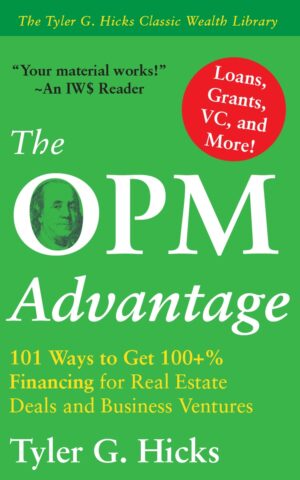
The same idea appears throughout The OPM Advantage (IWS-56) by Tyler G. Hicks. The book examines ways to secure outside financing for business and real-estate transactions, including trade credit and other forms of collateral. Study the alternatives so you can choose the right source of money for a particular deal, rather than trying to force every opportunity into a conventional bank loan.
Make the First Call Today
Your assignment is simple. Identify one supplier and one potential business buyer in the same industry. Ask the supplier what terms it offers. Ask the buyer what it plans to purchase. Write down the numbers and the dates. Then calculate what money would be required to complete a real order.
Start with the order. Study the money. Work the deal! You may discover that an opportunity which looks too large for your bank balance can become practical when you know the people, the contracts, and the financing methods that bring it together.