
Did you ever think of starting a business by looking for work that other businesses are too busy to find? Consider a small commercial cleaning company. The owner spends his days managing employees, buying supplies, answering customers, and checking jobs. Somewhere in his region, a public agency may be looking for precisely the work his company does. The opportunity may be listed on an official website. But he may never see it.
That gives you an idea. You find suitable government contracting opportunities, separate the promising ones from the unsuitable ones, and deliver a concise, carefully checked report to businesses that want more customers. You can begin with a computer, a telephone, and your own research effort. You do not have to bid on the contract yourself, buy trucks, or employ a crew of cleaners.
I call this a government contract finder business. For a beginning wealth builder, the most straightforward version is a fixed-fee research service. You sell the time, screening, and organization that busy owners need. You are not selling access to public information, and you are not promising that anybody will win a government contract.
Now, what about artificial intelligence? Use it to prepare searches, organize bid documents, identify missing qualifications, and draft useful opportunity briefs. But a human must still read the official solicitation, verify the deadline, and decide whether the customer can reasonably perform the work. That is where your service becomes valuable.
The Opportunity: Sell a Useful Report, Not a Government Contract
SAM.gov is the official U.S. government source for federal contract opportunities. You can search public opportunities for free. That is important. You should never claim that you own these listings or that clients must pay you to access them.
So why would anybody pay you? Because a plumber may know plumbing but have little time to search for solicitations, sort through amendments, read dozens of pages of requirements, and decide which opportunities deserve further review. A useful research service supplies that missing work.
Your customer can be a commercial cleaner, landscaper, security service, small IT provider, painter, office-supply company, equipment dealer, or other established business with the staff and ability to do the work. Start with one ordinary category. If you cannot understand what the buyer needs and what the supplier actually does, you cannot yet judge whether a listing is suitable.
Do not confuse the size of a government solicitation with your own revenue. A hypothetical $90,000 annual janitorial contract is not a $90,000 profit opportunity for you. Your business is the research service, for which you might test a $199 one-time screening report or a $299 monthly monitoring package. These are suggested test prices, not verified market averages.
Step 1. Find Customers for Your Government Contract Finder Business
I would begin with the customer, not with the bidding website. Choose one locality and one trade, such as commercial cleaning within fifty miles of your home. Make a list of twenty legitimate operators using business directories, local association websites, and personal referrals.
Then telephone the owners or managers. Ask one simple question: ‘Do you currently look for city, county, state, or federal work, or do you mainly depend on private customers?’ Let them explain. A company that has never submitted a government bid may need a different service from one already bidding.
Your first-call script: ‘Hi! I help commercial cleaning companies spot public-sector bidding opportunities that match their services and service area. I provide a concise screening report showing the scope, deadline, requirements, and official link. Do you already have somebody checking for new opportunities, or would a short sample be useful?’
Your first goal is not to sign a large contract. It is to identify a business that has the ability and appetite to pursue public-sector work. You need a real customer requirement before you spend hours researching notices.
Step 2. Write a One-Page Buyer Profile
If an owner is interested, ask permission to prepare a brief profile of the business. This is the filter against which you will judge every opportunity.
- Services: What does the company actually sell, and which services does it refuse?
- Territory: Which cities, counties, or states can it serve economically?
- Capacity: How many workers, vehicles, crews, or hours can it supply?
- Experience: What relevant contracts has it performed successfully?
- Registrations: Does it have an active SAM.gov registration and a Unique Entity ID, if necessary for the opportunity?
- Certifications: What small-business or set-aside statuses can it document, without guessing?
- Economics: What is its minimum attractive contract size, and what bid expenses can it afford?
You can use NAICS codes to help categorize the services a company provides. But a code alone does not establish that the company qualifies for a particular contract. Eligibility depends on the solicitation, the company’s actual status, and other requirements.
AI prompt: ‘You are preparing a government-contract opportunity research profile. From the following verified client information, produce a one-page screening checklist including services, geography, capacity, registrations, size/status restrictions, and minimum attractive contract value. Separate confirmed facts from missing questions. Do not invent certifications, past performance, registrations, or qualifications: [paste client-approved facts].’
Step 3. Search the Free Official Opportunity Sources
Begin with SAM.gov Contract Opportunities. Search by a combination of the customer’s trade, likely NAICS codes, place of performance, federal agency, notice type, and dates. Read the actual opportunity notice and attachments. Some notices are requests for information or sources-sought notices, not immediate invitations to submit a price.
You can also investigate state procurement portals, county purchasing pages, municipal bid boards, and school-district purchasing offices. Their processes vary, so follow each agency’s official instructions. Avoid relying exclusively on an aggregator’s summary when the controlling documents are available from the issuer.
- Choose one customer-approved service category and two or three useful search terms.
- Run the search at the relevant official portal and record the date and time you searched.
- Open each promising notice and identify the buyer, required work, location, response date, and status.
- Download or link the solicitation documents and amendments, according to the portal’s terms.
- Record the official notice link, solicitation number, and next action in a tracking sheet.
Do not advertise yourself as an official representative of the government or claim special access. You are an independent commercial researcher organizing public information for a paying customer.
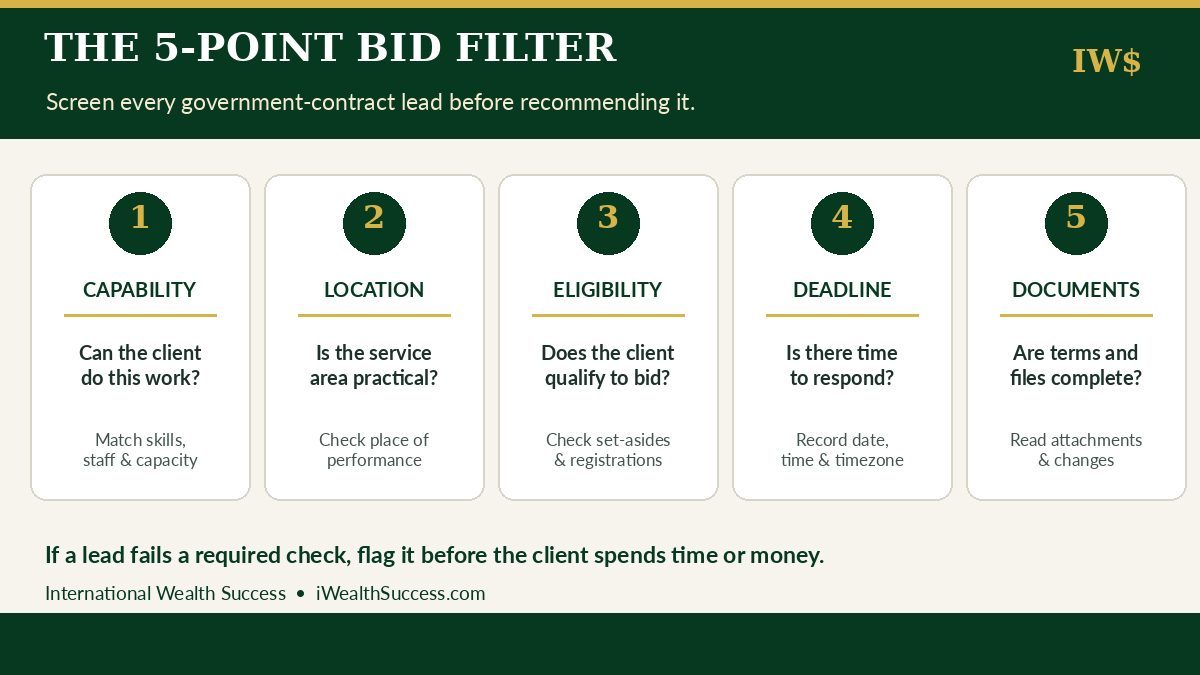
Step 4. Apply the Five-Point Bid Filter
Here is the most important system in this business. Before you recommend a lead, ask five questions. A single serious mismatch may make the opportunity useless to your customer.
- Capability: Does the company actually perform this service, and can it meet the technical specifications?
- Location: Can it serve the place of performance profitably, including travel, staffing, and travel costs?
- Eligibility: Does the notice require registrations, licenses, security clearances, certifications, size status, or set-aside qualifications the company possesses?
- Deadline: Is there enough time for the company to review the requirements, ask questions, prepare a response, and submit correctly?
- Documents: Have you reviewed the official notice, attachments, amendments, mandatory site visits, and submission instructions?
Imagine a cleaning business with twelve employees. You find a facility-services solicitation in its county. Exciting! But then you notice it requires overnight coverage at multiple secure facilities, a mandatory site visit that occurred last week, and qualifications the company cannot document. That is not a good lead, regardless of how large the contract might be.
Use the five-point screen every time. It will save your clients wasted bidding effort, and it will protect your reputation.
AI prompt: ‘You are a bid-screening research assistant, not a contracting officer or lawyer. Compare this official solicitation text and amendments against the verified client profile below. Evaluate capability, location, eligibility, deadline, and documents. For every criterion, mark PASS, FAIL, or UNKNOWN, explain why, and quote the exact source passage supporting it. Flag mandatory site visits and submission rules. Do not infer eligibility from a NAICS code alone and do not make a bid/no-bid decision for the client. Client profile: [facts]. Solicitation: [text and source links].’
Step 5. Turn Your Research into a Report an Owner Will Read
An equipment contractor does not want sixty pages of copied government notices. He wants a list of opportunities that deserve a decision. You could prepare a weekly report containing three to five carefully screened leads, although on some weeks there may be none.
Give each opportunity a short summary with its official title, solicitation number, agency, work location, work description, response deadline and time zone, estimated value only if actually disclosed, apparent eligibility issues, required next action, and link to the controlling documents. Show any unknown facts plainly.
Sample opportunity brief
Opportunity: [Official solicitation title and number]
Agency: [Verified issuing agency]
Place of performance: [Location]
Response due: [Date, time, time zone]
Customer fit: [Pass/Fail/Unknown based on five checks]
Potential obstacle: [Exact required certification, site visit, or document]
Recommended next action: [Review section or ask purchasing officer a specific question]
Official source: [Direct solicitation link]
A short explanation written in plain English can be worth more to an owner than a much longer report filled with unexplained abbreviations. Your report should also state when the official source was last checked because opportunities can be amended, canceled, or extended.
Step 6. Make Your First Sale with a Fixed-Fee Offer
I would not start by asking for a percentage of a government contract. Government procurement has rules about contingent fees and representations. Federal Acquisition Regulation Subpart 3.4 addresses contingent-fee arrangements in federal contracting, and there may be further rules for the parties and services involved.
Instead, sell a defined research deliverable. Here is a beginning offer you can use:
PUBLIC CONTRACT OPPORTUNITY SCREEN: $199
I will research one agreed service category and geographic area, review available official notices, and deliver up to five screened opportunities with sources, deadlines, fit notes, and questions to resolve. If no suitable current opportunities appear, I will deliver the search results and explain why the listings failed the screening criteria. Delivery within five business days after receipt of the buyer profile. No guarantee of a contract award.
Your cost is mainly your time. Suppose you complete four $199 reports in a month. That produces $796 in gross service revenue before taxes, software, and other costs. A client who needs a weekly review might instead pay an agreed monthly fee. At six clients paying an illustrative $299 per month, gross monthly billings would be $1,794. Those are arithmetic examples, not promised results.
Get the scope and price agreed in writing before performing substantial work. Keep your customer’s procurement login credentials, private business records, and bid submissions out of your possession unless you have a proper reason, authorization, and appropriate safeguards. The client retains responsibility for deciding whether to bid and submitting its own offer.
Step 7. Build a Repeatable Weekly Research Service
After your first report, ask the owner, ‘Would you like me to check these sources every Tuesday and send you only opportunities worth reviewing?’ That is how a one-time assignment can become continuing service.
Build a simple weekly checklist: check the saved search, review new and updated notices, run the five-point filter, verify deadlines, prepare the report, send it to the client, and record any feedback. Track which leads the customer read, which it rejected, and why. Improve the buyer profile as you learn.
You can eventually serve multiple companies in different trades. But disclose possible conflicts when you provide the same opportunity to competing clients, and agree in advance on confidentiality, exclusivity if any, and what services are being sold. Your product is dependable research. Guard that reputation.
Once you can deliver a consistently valuable report, you may hire a researcher to collect initial listings while you review the best opportunities and speak with customers. Develop documented procedures and trained help. The result can be a small business that does not depend entirely on your own searching hours.
The Three AI Prompts That Make This Business Faster
You have already seen two prompts. Here is a third, designed to turn verified source information into your weekly customer report.
AI PROMPT: WEEKLY CONTRACT FINDER REPORT
Act as an exacting procurement research editor. Build a one-page report from the following verified SAM.gov or state/local government notices. For each opportunity show title, solicitation number, agency, scope, place of performance, deadline including time zone, mandatory requirements, eligibility concerns, official URL, and one next action. Include a confidence note listing facts not yet verified. Do not invent notices, deadlines, contract values, certifications, awards, or chances of winning. Source records: [paste verified entries]. Client profile: [paste approved profile].
Remember, the AI produces a draft. You check it against the official notices, confirm that nothing has changed, and correct mistakes before selling it. The person paying you expects a useful decision aid, not an impressive-looking guess.
Your First Seven Days: The Government Contract Finder Assignment
- Day 1: Choose one trade such as commercial cleaning, landscaping, facilities maintenance, or office equipment. Identify twenty established firms.
- Day 2: Contact ten owners or managers and ask whether public-sector work is relevant to their plans.
- Day 3: Speak to the remaining ten. Get permission to prepare one realistic buyer profile for an interested company.
- Day 4: Search SAM.gov and the relevant state or local procurement source. Record official links and dates.
- Day 5: Apply the five-point bid filter, including amendments and mandatory prerequisites. Reject bad-fit notices.
- Day 6: Prepare a sample one-page report with the official source references and verified unknowns.
- Day 7: Offer a $199 paid screening report or a clearly scoped recurring research service, then ask the owner what additional information would make the report more useful.
The free APEX Accelerators network can help qualified small businesses understand government contracting. You should know about it. Your paid service has to provide genuine convenience and custom research beyond what customers can obtain freely. Never imply that your service replaces a contracting adviser, an agency procurement officer, or legal counsel.
Grow Your Government Contract Finder Business
You may decide to specialize in public contract opportunities. Or you may discover that your best customers need help finding equipment, suppliers, commercial buyers, or other business opportunities. The basic habit is the same: ask what a real buyer needs, locate relevant possibilities, verify them, and put the useful information in the buyer’s hands.
For the wider business of finding commercial opportunities and arranging introductions, study The IWS Finder’s World Business Success Kit (K-37). It covers finding methods, deal-making concepts, and forms that can help you explore additional markets. Before accepting transaction-based compensation, check the laws and contractual rules that apply to the exact type of work.
Explore the IWS Finder’s World Business Success Kit: Here is the complete product listing from our store, including its current price and purchase options.

Here’s your assignment for today: Choose one trade and call five possible clients. Ask whether they are looking for public-sector contracts, and if not, why not. You will learn more from those conversations than from another week of looking at business ideas. An ordinary person can build a surprisingly valuable service by repeatedly doing one useful job well!